Triquetra Meaning and Gift Ideas for Celtic Jewelry Fans
Triquetra Meaning: Trinity Knot Symbolism, History & Gift Ideas
The triquetra, also known as the Trinity knot, is one of the most recognizable symbols in Celtic-inspired jewelry. Its three interwoven points have made it a popular symbol of unity, eternity, connection, balance, and the power of three.
Today, the triquetra appears in Celtic jewelry, Norse-inspired designs, pagan and Wiccan symbolism, Christian art, tattoos, and alternative fashion. Part of its lasting appeal is that there is no single meaning that fits every person who wears it.
In simple terms, the triquetra is a three-pointed interlaced symbol commonly interpreted today as representing three connected parts of a whole. Those three parts might represent body, mind and spirit; past, present and future; life, death and rebirth; or another personal connection that matters to the wearer.
That flexibility makes the Trinity knot especially meaningful in jewelry and gifts.
Shop the Triquetra Celtic Knot Stainless Necklace
What Is a Triquetra?
The word triquetra refers to a three-cornered or three-pointed figure. The familiar knot version is formed from curved lines that weave together to create three connected points.
Unlike a design with a clear beginning and end, Celtic-style triquetra knotwork appears to flow continuously. This is one reason the symbol is frequently associated today with ideas such as eternity, lasting relationships and unbroken connection.
The number three also plays an important role in many cultures and spiritual traditions. As a result, different groups have adopted the triquetra and given its three sections meanings that reflect their own beliefs.
There is an important distinction, however: not every meaning associated with the triquetra today can be proven to have been its original ancient meaning. Many familiar interpretations developed later or are modern personal and spiritual interpretations.
That does not make those meanings less important to the people who wear the symbol, but understanding the difference between historical evidence and modern symbolism makes the triquetra even more interesting.
What Does the Triquetra Mean?
There is no single universal triquetra meaning. Its symbolism depends on the tradition, design and person wearing it.
One of the most common interpretations is unity. Three separate sections join together to form one complete symbol, making the triquetra a natural representation of people, ideas or stages of life that remain connected.
It is also commonly associated with eternity and continuity because its interlaced lines can appear to have no obvious beginning or end.
Many people use the three points to represent a personal group of three, such as body, mind and spirit, past, present and future, or life, death and rebirth.
For others, the triquetra represents a relationship between three people, the bond between generations of a family, or three important parts of their own life.
This ability to give the symbol a personal meaning is one reason triquetra necklaces and pendants make thoughtful gifts.
The History of the Triquetra and Celtic Knotwork
Interlaced patterns are strongly associated with the art of early medieval Ireland and Britain.
Researchers at Trinity College Dublin describe spirals, crossings, knotwork and repeating interlace as important features of Insular art, the distinctive artistic tradition that developed in Ireland and Britain during the early medieval period.
One of the most famous examples is the Book of Kells, created around 800 AD. The manuscript contains extraordinarily detailed decoration and interwoven designs and remains one of the best-known surviving examples of early medieval Insular art.
The triquetra and related three-part interlace designs were not limited exclusively to Ireland, however.
The British Museum, for example, has an 11th-century buckle classified as Viking and Late Anglo-Saxon whose decoration includes a triquetra knot. Other surviving early medieval objects also contain related three-part interlace forms.
This is why it is more accurate to think of the triquetra as a symbol that appears across interconnected early medieval artistic traditions rather than claiming that it belonged exclusively to one culture.
Is the Triquetra Celtic or Norse?
The triquetra is strongly associated today with Celtic art and Celtic knot jewelry, but versions of the design also appear in Norse and Anglo-Saxon contexts.
Viking-age artists used many forms of interlace, animal ornament and knotwork, and surviving objects show that the triquetra motif was among the designs they used.
For that reason, a triquetra can work naturally in either Celtic-inspired or Viking-inspired jewelry.
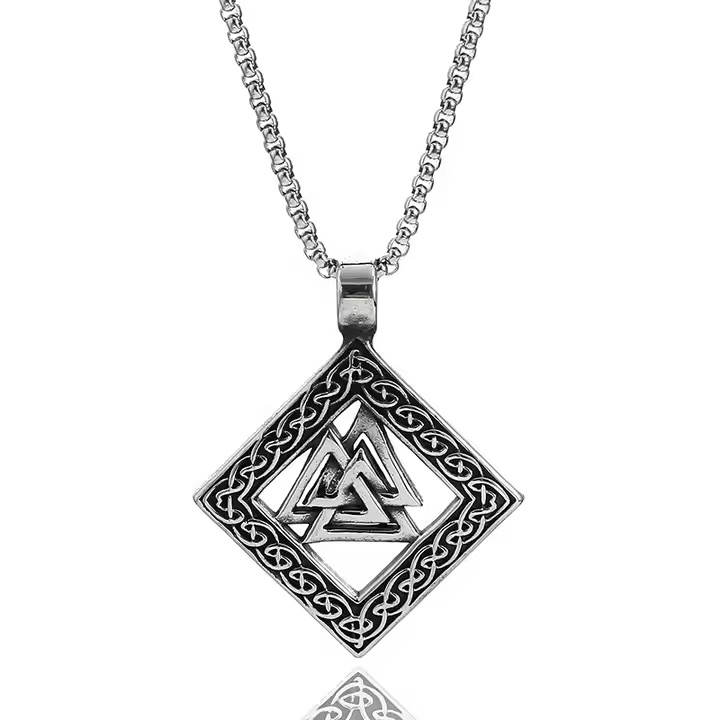
However, the triquetra should not be confused with the Valknut. The Valknut is a separate Norse symbol usually shown as three interlocking triangles. Although both designs involve the number three and may appear in modern Viking jewelry, they are different symbols.
See the Norse Triquetra Celtic Knot Stainless Necklace

Is the Triquetra a Pagan Symbol?
The triquetra is widely used in modern pagan and Wiccan jewelry and symbolism.
Some modern spiritual interpretations connect its three points with the Triple Goddess, stages of life, natural cycles, or the relationship between body, mind and spirit.
These interpretations can have deep personal meaning, but they should not automatically be described as documented beliefs held by all ancient Celts.
Modern pagan traditions often give historic symbols new or expanded meanings, and the triquetra’s three-part design makes it particularly adaptable to those beliefs.
Is the Triquetra a Christian Symbol?
The triquetra is also used as a Christian symbol.
Its three connected parts make it a natural representation of the Holy Trinity — the Father, Son and Holy Spirit — three persons united as one.
This Christian interpretation is the reason the triquetra is commonly called the Trinity knot.
The same symbol can therefore carry very different meanings depending on the wearer. One person may see Christian Trinity symbolism while another sees Celtic heritage, spiritual balance, family connection or simply an appreciation for Celtic knotwork.
What Does a Circle Around a Triquetra Mean?
Many triquetra designs place the three-part knot inside or across a circle.
Today, the circle is commonly interpreted as representing wholeness, eternity, protection or an unbroken connection. Because a circle has no obvious beginning or end, it reinforces the idea of continuity already suggested by the interwoven knot.
A triquetra surrounded by a circle is therefore often chosen to symbolize a bond that is intended to endure.
As with many Celtic-style symbols, however, it is best to describe this as a common modern interpretation rather than a single historically proven ancient definition.
Why Is Triquetra Jewelry a Meaningful Gift?
Symbolic jewelry works best when the wearer can make the meaning their own, and that is one of the triquetra’s greatest strengths.
A Trinity knot necklace can represent a lasting friendship, three members of a family, a couple and their child, three generations, a spiritual journey, personal growth or simply an appreciation for Celtic heritage and knotwork.
It can also quietly express a message such as “we are connected,” “our bond continues,” “your journey matters,” or “three parts make one whole.”
That makes triquetra jewelry suitable for birthdays, graduations, anniversaries, spiritual milestones, Renaissance fairs, Celtic festivals, pagan and Wiccan collections, Viking-inspired outfits and everyday alternative style.
How to Choose Triquetra Jewelry as a Gift
For someone who prefers simple everyday jewelry, a clean stainless steel triquetra pendant is an easy choice. Stainless steel pairs well with casual clothing and offers a design that can be worn regularly without looking overly formal.
Someone interested in Celtic spirituality, pagan symbolism or nature-inspired jewelry may prefer a design that combines the Trinity knot with the Tree of Life.
For Viking or Norse-inspired style, look for heavier shapes, darker finishes and bold knotwork.
For gothic or alternative fashion, triquetra pendants work especially well with black clothing, antique silver tones, leather, layered chains and other symbolic jewelry.
Triquetra Gift Ideas from There Be Skulls
For a classic design, our Triquetra Celtic Knot Stainless Necklace offers a clean three-part knot that works well for everyday Celtic, spiritual and alternative jewelry.
For a darker Viking-inspired look, see the Norse Triquetra Celtic Knot Stainless Necklace. It combines the familiar Trinity knot with a bolder Norse-style presentation.
For someone drawn to nature and spiritual symbolism, the Celtic Tree of Life Trinity Knot Pendant Necklace combines two popular designs: the Tree of Life and the Trinity knot. Together they create a piece associated today with growth, connection, balance and continuity.

You can also explore our complete Celtic Knot Jewelry and Gifts Guide for more Celtic crosses, Trinity knots, Viking-inspired jewelry and symbolic gift ideas.
Frequently Asked Questions About the Triquetra
What does a triquetra symbolize?
The triquetra is commonly interpreted today as a symbol of unity, eternity, connection and the power of three. Its three points can also represent personal groups of three, such as body, mind and spirit or past, present and future. There is no single meaning that applies to every tradition or wearer.
Is a triquetra the same as a Trinity knot?
Yes. Trinity knot is one of the most common modern names for the interlaced three-pointed triquetra, especially when the design is used in Celtic or Christian jewelry.
Is the triquetra Celtic?
The triquetra is strongly associated with Celtic and Insular art, and today it is one of the most recognizable designs used in Celtic-inspired jewelry. However, similar triquetra designs also appear on surviving Anglo-Saxon and Viking-age objects, so the motif was not exclusive to ancient Ireland.
Is the triquetra Viking?
Triquetra motifs appear on some Viking-age objects, making the design historically appropriate in Norse-inspired artwork and jewelry. However, it is not exclusively a Viking symbol and should not be confused with the Valknut.
Is the triquetra a pagan or Wiccan symbol?
It is widely used by modern pagans and Wiccans and can represent concepts such as natural cycles, the Triple Goddess or three connected parts of life. These are important modern spiritual interpretations, although they should not automatically be presented as documented beliefs of all ancient Celtic people.
Does the triquetra mean protection?
Protection is one modern interpretation of the triquetra, particularly when the knot is enclosed by a circle. Other common meanings include unity, eternity, balance and connection. The meaning ultimately depends on the tradition and the person wearing it.
What does a triquetra necklace mean as a gift?
A triquetra necklace can symbolize an enduring bond, friendship, family connection, love, spiritual growth or a meaningful group of three. Because the symbolism is flexible, the recipient can give the necklace a meaning that reflects their own life.
Final Thought
The triquetra has survived as a powerful design because it can be both historic and personal.
Its interwoven three-part form connects it visually with centuries of Celtic, Insular and early medieval knotwork, while modern wearers continue to give it meanings involving unity, protection, spirituality, family, love and eternity.
There does not need to be one universal triquetra meaning for the symbol to matter.
For some, it represents the Holy Trinity. For others, it represents pagan spirituality, Celtic heritage, three people joined together, three stages of life or an unbroken personal connection.
And for some people, it is simply a beautiful piece of Celtic knotwork.
That ability to carry a meaning chosen by the wearer is exactly what makes triquetra and Trinity knot jewelry such an enduring and personal gift.