Skull Beads for Jewelry Making: Types, Sizes, Materials & Project Ideas
Skull beads for jewelry making can turn a simple bracelet, necklace, earring set, or keychain into something gothic, playful, biker-inspired, Halloween-ready, or completely personal. The hard part is not finding a skull shape—it is choosing the right material, bead dimensions, hole size, and stringing method for the project.
This guide explains how ceramic, howlite, and carved bone skull beads differ; how to read sizes such as 10mm x 8mm or 15mm x 13mm; how to match cord to the bead hole; and how many beads you may need. You can also browse the current skull beads collection while planning your design.

Quick Guide to Choosing Skull Beads
- For a first stretch bracelet: start with 8mm x 10mm or 10mm x 12mm beads and 0.5–0.8mm jewelry elastic, provided the elastic passes through the actual hole comfortably.
- For bright color: choose ceramic or porcelain skull beads in blue, cyan, orange, purple, or multicolor finishes.
- For a pale stone look: choose howlite skull beads.
- For a rugged, carved look: consider yak bone, ox bone, or a larger flat bone focal bead.
- For earrings: smaller 8mm x 10mm or 10mm x 8mm beads are easier to balance than large statement beads.
- For keychains and zipper pulls: use one large skull or three to five smaller beads on sturdy cord, an eye pin, or a head pin.
Skull Bead Materials: Ceramic, Howlite, and Bone
Material changes the color, weight, texture, durability, and mood of a finished piece. There Be Skulls currently carries 11 skull-bead products across ceramic, howlite, and carved bone styles.
| Material | Typical look | Sizes currently available | Good project uses |
|---|---|---|---|
| Ceramic / porcelain | Glossy or colorful, with visible carved skull detail | 10mm x 8mm, 13mm x 10mm, 15mm x 13mm, and 16mm x 12mm | Bracelets, necklaces, colorful earrings, keychains, zipper pulls, Halloween crafts |
| Howlite | Pale, stone-like, and easy to pair with black, silver, lava, or crystal beads | 8mm x 10mm and 10mm x 12mm | Repeating bracelets, spacer patterns, earrings, chokers, monochrome gothic designs |
| Carved bone | Natural, rugged, and hand-carved in appearance | Yak bone around 9mm x 10mm, ox bone around 13mm x 14mm, and flat yak bone around 1.75 inches | Statement jewelry, focal pendants, biker designs, leather-cord pieces, keychains |
Ceramic and Porcelain Skull Beads
Ceramic skull beads offer the widest color selection. Current options include blue ceramic porcelain skull beads, blue-green 13mm x 10mm beads, cyan blue beads in three sizes, orange skull beads, purple 13mm x 10mm beads, and a 25-piece multicolor strand.
Ceramic beads are rigid and hold crisp color well, but they can chip if dropped onto a hard surface or squeezed by pliers. Use nylon-jaw tools when possible, avoid overtightening wire loops against the bead, and separate larger ceramic skulls with small spacer beads if the faces knock together.
Howlite Skull Beads
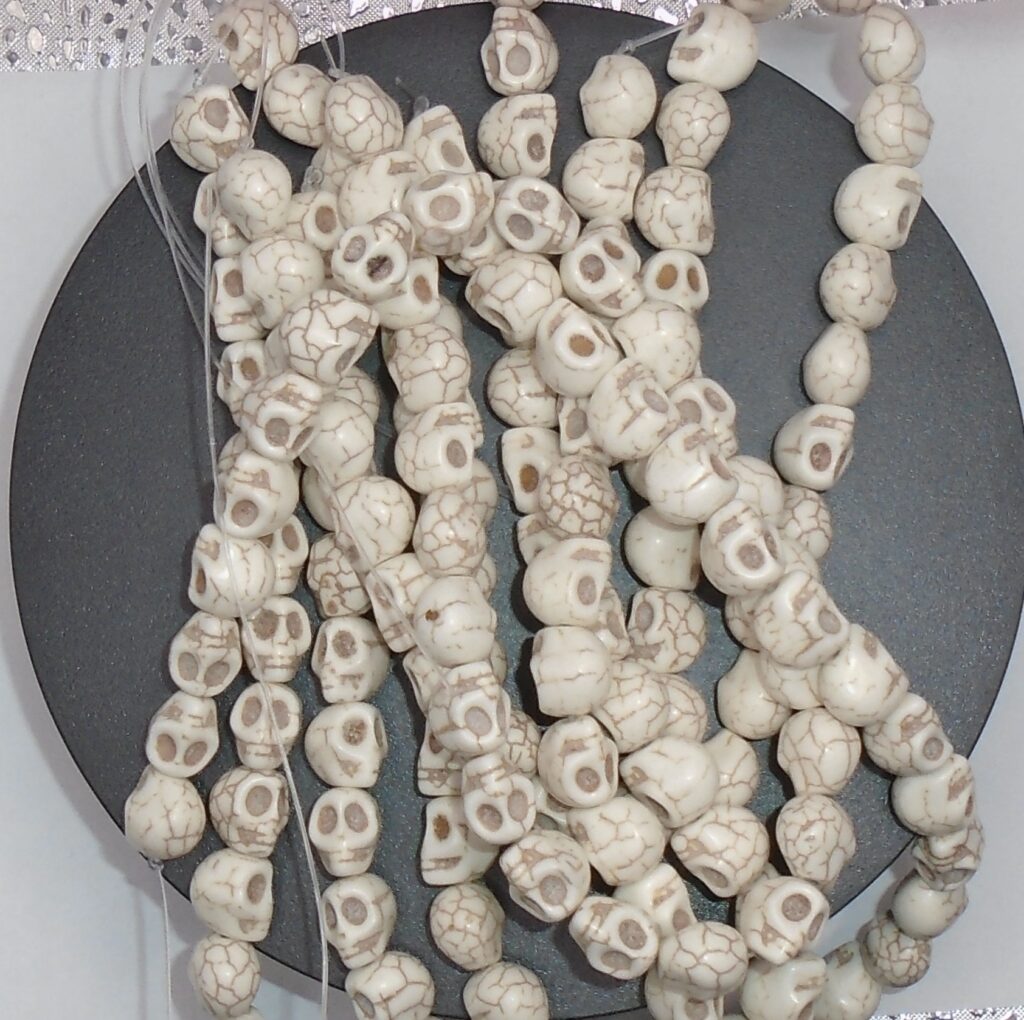
Howlite skull beads have a pale stone-like appearance that works especially well with black cord, stainless steel findings, lava beads, dark crystals, or wood. The smaller 8mm x 10mm howlite skull beads are useful for earrings and tighter repeating patterns. The larger 10mm x 12mm howlite skull beads come in a 32-piece strand and create a stronger focal pattern.

Yak Bone, Ox Bone, and Flat Bone Skull Beads
The bone listings are the most distinctive options in the collection. The yak bone skull bead strand contains about 40 carved beads measuring approximately 9mm x 10mm. The larger ox bone skull beads work as statement accents. A flat hand-carved yak bone skull bead, approximately 1.75 inches long, can serve as a pendant, centerpiece, choker focal, or mixed-media element.
Because these listings identify animal bone, makers who avoid animal-derived materials should choose ceramic or howlite instead. Natural and hand-carved pieces can also vary slightly, so plan a layout using the actual beads before cutting cord.

How to Read Skull Bead Sizes
A size such as 13mm x 10mm describes two outside dimensions of the bead. Product listings do not always present height and width in the same order, and the stringing hole may run through either dimension. For bead-count calculations, the important number is the bead’s length along the stringing path.
Measure one actual bead from hole to hole with a millimeter ruler or caliper. Then use that measurement in your calculation. This is more reliable than assuming the first number in the product name is always the amount of bracelet space the bead will occupy.
- 8mm–10mm skull beads: compact enough for earrings, mixed patterns, and lighter bracelets.
- 12mm–14mm skull beads: a noticeable medium focal size for bracelets and necklaces.
- 15mm–16mm skull beads: bold statement beads that fill a strand quickly.
- 1.75-inch flat skull beads: best treated as a pendant or single focal element rather than a repeating bracelet bead.
Hole Size: The Detail That Determines Your Cord
Hole size matters as much as the outside bead dimensions. The blue-green 13mm x 10mm beads and cyan blue ceramic beads list an approximate 1.5mm hole. The 15mm x 13mm blue ceramic option also lists an approximately 1.5mm hole. Do not assume every color, size, howlite bead, or carved bone bead has the same opening.
A cord should pass through without scraping, forcing, or damaging the finish. Leave extra room if the cord must pass through a bead twice, as it might near a knot, clasp, or repair point.
| Stringing material | Good starting range | Best for | Watch for |
|---|---|---|---|
| Jewelry elastic | About 0.5–0.8mm | Beginner stretch bracelets | Pre-stretch it; verify the knot and any doubled section fit the hole |
| Braided nylon or waxed cord | About 0.5–1.0mm | Adjustable bracelets, chokers, and keychains | Thicker knots may not recess into the bead |
| Flexible beading wire | Choose a diameter well below the hole size | Clasped necklaces and durable multi-bead strands | Requires crimps, a clasp, and correct crimping tools |
| Head pins or eye pins | Gauge must pass freely through the bead | Earrings, charms, and linked components | Do not force a pin through an uneven ceramic or carved hole |
| Leather cord | Only after measuring the hole | Rugged chokers and bone-bead designs | Many leather cords are too thick for small skull beads |
Elastic vs. Cord vs. Beading Wire
Choose Elastic for Simple Skull Bead Bracelets
Elastic is quick, clasp-free, and beginner-friendly. It works best when the bead holes are smooth and comfortably larger than the elastic. Pre-stretch the elastic, use a secure knot recommended by the elastic manufacturer, and add only a tiny amount of compatible flexible jewelry adhesive if the manufacturer allows it. Household superglue can make some elastics brittle.
Choose Cord for an Adjustable or Rugged Look
Braided nylon and waxed polyester cord suit sliding knots, macramé sections, keychains, and leather-inspired styles. Cord also lets you space skulls with knots so ceramic beads do not strike each other. Check whether the design requires a second pass through any hole before choosing the diameter.
Choose Beading Wire for a Clasped Necklace
Flexible beading wire supports longer designs and heavier beads without relying on one stretch knot. Use the crimp size recommended for the wire, finish with a clasp, and place small spacer beads around rough or irregular holes.
How Many Skull Beads Do You Need?
Use this basic estimate:
Finished beaded length in millimeters ÷ bead length along the stringing path in millimeters = approximate bead count.
One inch equals 25.4mm. Round up for a fully beaded strand, then adjust for clasps, spacers, knots, focal beads, and the actual fit. Skull shapes may not nest as tightly as round beads, so always dry-layout the design before stringing.
Approximate Beads for a 7-Inch Bracelet
| Bead space along cord | Approximate full-strand count |
|---|---|
| 8mm | 23 beads |
| 10mm | 18 beads |
| 12mm | 15 beads |
| 13mm | 14 beads |
| 15mm | 12 beads |
| 16mm | 12 beads |
For a comfortable stretch bracelet, measure the wearer’s wrist and add roughly 1/4 to 1/2 inch depending on bead size and preferred fit. Larger beads sit farther from the wrist, so they may need slightly more finished length. If you add metal spacers or round accent beads, subtract their combined width before calculating the number of skulls.
Approximate Beads for Necklaces
| Finished length | 10mm beads | 13mm beads | 15mm beads |
|---|---|---|---|
| 16 inches | 41 | 32 | 28 |
| 18 inches | 46 | 36 | 31 |
| 20 inches | 51 | 40 | 34 |
| 24 inches | 61 | 47 | 41 |
These figures assume every millimeter is filled by skull beads. A design with chain, cord, spacers, or a pendant will use fewer.
Earrings and Keychains
- Simple drop earrings: one skull bead per earring, plus a small accent bead if desired.
- Stacked earrings: two or three small skull beads per earring.
- Short keychain or zipper pull: one large skull or three to five small beads.
- Long bag charm: five to nine beads mixed with spacers, chain, or tassels.
What Can You Make From One Strand?
- A 10-piece ceramic strand is ideal for a focal bracelet combined with round beads, two pairs of earrings plus a keychain, or several zipper pulls.
- A 25-piece strand of 15mm x 13mm ceramic skulls can supply one bold full bracelet with beads left for a charm or earrings, depending on the hole direction and wrist size.
- A 32-piece strand of 10mm x 12mm howlite skulls can cover a full bracelet and leave beads for earrings, a keychain, or a mixed necklace.
- A roughly 40-piece strand of 9mm x 10mm yak bone skulls can support two smaller bracelets or one necklace section with accent beads.
These are planning estimates, not guarantees. Natural variation, bead orientation, spacers, and finished sizing all affect the final count.
Seven Skull Bead Project Ideas
1. Beginner Black-and-White Stretch Bracelet
Alternate 8mm x 10mm howlite skulls with black lava or glass beads. Use jewelry elastic that moves freely through every hole. Add one stainless steel spacer as a simple center marker.
2. Multicolor Skull Bracelet
Use the 25-piece multicolor ceramic strand to build a bright repeating pattern. Separate the skulls with tiny black seed beads so the ceramic edges do not rub directly against each other.
3. Three-Skull Focal Bracelet
Center three 13mm x 10mm blue-green, purple, or cyan skulls between plain round beads. This is an efficient way to turn a 10-piece strand into several coordinated bracelets.
4. Mismatched Gothic Earrings
Place one small ceramic or howlite skull on each head pin, then vary the accent colors above them. Keep the total weight comfortable and make sure loops are fully closed.
5. Skull Keychain or Zipper Pull
Stack one larger skull with two smaller beads on sturdy cord or linked pins. Attach the component to a split ring or swivel clasp. Avoid elastic for load-bearing keychains.
6. Carved Bone Statement Necklace
Use one larger ox bone skull or the flat 1.75-inch skull as the central focal. Pair it with dark cord, wood, metal, or lava beads. Measure the focal hole before buying cord.
7. Halloween or Day-of-the-Dead-Inspired Color Story
Build a removable bag charm or bracelet using orange, cyan, purple, and multicolor ceramic skulls. Let color and craftsmanship guide the design without presenting a decorative project as a substitute for the traditions or meaning of Día de los Muertos.
Simple Skull Bead Bracelet Steps
- Measure the wrist and decide how loose the bracelet should feel.
- Measure one skull bead from hole to hole and estimate the count.
- Test the elastic or cord through every bead before cutting.
- Lay out the full pattern on a bead mat or towel.
- Cut extra stringing material for holding and knotting—four to six extra inches is usually easier to handle.
- String the beads and test the fit before tying.
- Finish with the knot, crimp, or clasp recommended for the chosen material.
- Trim only after the connection is secure. Follow adhesive and cure-time instructions if using a compatible jewelry adhesive.
Skull Bead Care and Safety
- Wipe beads with a soft dry or slightly damp cloth; avoid long soaking.
- Keep ceramic beads away from hard impacts.
- Avoid harsh chemicals on finishes, natural materials, elastic, and cord.
- Check bracelets and keychains periodically for worn cord, open loops, or cracked beads.
- Beads are small parts and are not suitable for young children. Store finished supplies securely.
Shop Skull Beads by Type
- Colorful ceramic: blue, blue-green, cyan, orange, purple, and multicolor.
- Howlite: 8mm x 10mm and 10mm x 12mm.
- Carved bone: yak bone 9mm x 10mm, ox bone 13mm x 14mm, and the flat yak bone focal bead.
See every current style in the skull beads collection, or browse more unusual components and accessories in Rare Finds.
FAQ: Skull Beads for Jewelry Making
What size skull beads are best for bracelets?
Beads around 8mm x 10mm or 10mm x 12mm are versatile for repeating bracelets. Sizes around 13mm to 16mm create a bolder bracelet with fewer beads. Always use the hole-to-hole measurement when planning the count.
How many 10mm beads make a 7-inch bracelet?
About 18 beads fill 7 inches if each bead occupies 10mm along the string and no spacers are used. Adjust for fit, knot space, bead shape, and any accent beads.
What cord fits a 1.5mm bead hole?
A 0.5–0.8mm jewelry elastic or similar cord is a practical starting range, but test the actual bead. A knot, doubled cord, eye pin, or irregular hole may require more clearance.
Can skull beads be used for earrings?
Yes. Small ceramic or howlite skull beads work well for drop earrings. Use correctly sized head pins or eye pins, keep the pair balanced, and check the finished weight for comfort.
Are all skull bead holes the same size?
No. Some ceramic listings specify an approximately 1.5mm hole, but not every color, size, or material lists the same measurement. Check the individual product details or measure the bead before choosing cord.
Are ceramic skull beads durable?
Ceramic beads are suitable for normal jewelry and craft use, but they can chip or crack under hard impact. Use gentle tools, avoid overtightening, and consider spacer beads in high-contact designs.